A concentrated publication and refinement phase kept the same two-adic obstruction while removing machinery: first a bounded-gap Hilbert selector, then an all-index tagged Hilbert lift, and finally the Gaussian digit-sum walk.
Source-of-truth boundary. These are personal working notes and discovery artifacts, not proof certificates. The current Gaussian proof and joint Cambie–Kalviainen paper contain the authoritative argument; the Hilbert material below records the route that exposed the tag geometry.
Separate unit-step follow-up · September 6. A line-by-line AI-assisted audit found no core gap in Kalviainen’s six-step/6D draft, using Cambie’s offsets and Shallit’s encoding. Human collaborator review and Lean certification remain pending. The exact minima remain open; six-vector optimality was checked only within the stated fixed-tag construction scheme.
01
Build a course, not a summary
Understanding came from teaching the proof back.
The formal argument existed, but compact exposition was not enough. A synced Obsidian vault turned each point of confusion into its own linked lesson, then used from-memory prompts to decide what had to be explained next.
Erdos-193-StudyObsidian vault · Aug 20–26
13 linked lessons2 synthesis references
Begin in plain EnglishDefine the problem, then answer calibration questions from memory.
Split the hidden prerequisitesFinal digits, notation direction, and Hilbert orientation.
Give each mechanism one lessonState encoding, powers of two, and the lifted-point contradiction.
Open the pair-law black boxTerminal state, planar scales, and finally one shared mismatch.
Compress only after understandingA formula cheat sheet and proof skeleton became usable references.
What changed in understanding
The vault was not after-the-fact documentation. It was the method that made the proof personally reconstructible. “Trace. Encode. Lift.” supplied the global map; separate lessons then isolated terminal state, coordinate encoding, the two-adic fingerprint, and the endpoint parity contradiction.
Each lesson ended with a recall skeleton or calibration questions. An unclear answer was evidence that another prerequisite was missing—not a cue to repeat the same compressed explanation.
The seven-day learning sequence
August 20: establish plain-language meaning and test recall.
August 21–22: separate the decoder, state encoding, valuation, and collinearity jobs.
August 23–25: rebuild the pair law until both sides became the same first-mismatch odometer.
August 26: consolidate the now-understood proof into a notation sheet and proof skeleton.
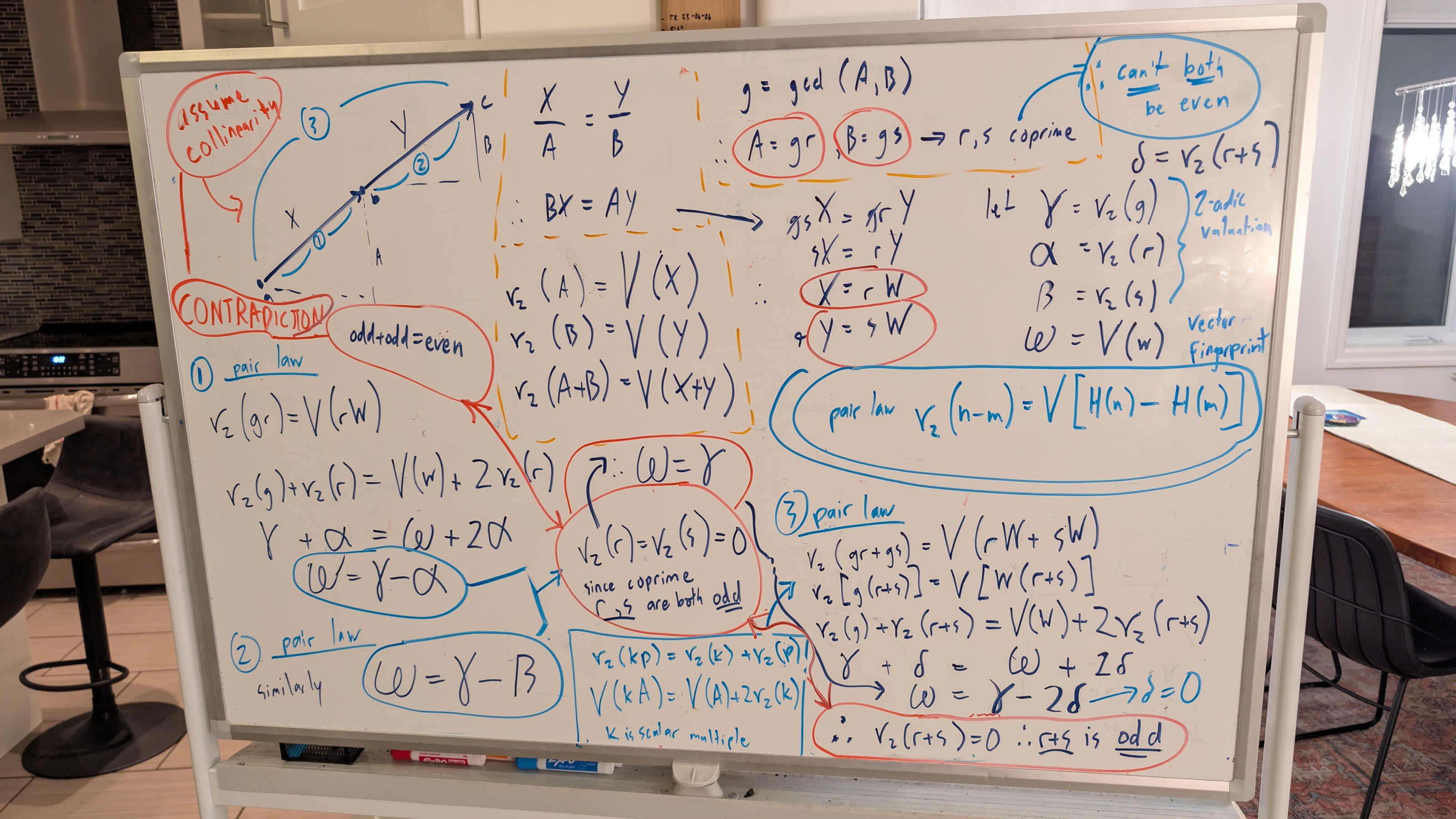
Start by pretending that three lifted points lie on one line. The board turns that geometric picture into adjacent height gaps, planar chords, and finally a parity impossibility.
Collinearity on the left; the gcd reduction in the middle; three pair-law applications and the odd-versus-even contradiction on the right. Select the photograph to open it at full size.
What changed in understanding
The no-collinearity theorem stopped looking global. It was enough to understand three gaps and three chords. With
\(A=gr,\quad B=gs,\) \(X=rW,\quad Y=sW.\)
the first two pair-law equations force the coprime numbers \(r,s\) to be odd. The third pair sees \(r+s\), which cannot also be odd. The final proof keeps this skeleton and makes every divisibility step explicit.
Marks worth reading
“Assume collinear” and the three-point diagram.
\(BX=AY\), the common-vector reduction, and the labels \(A=gr\), \(B=gs\).
The circled reminder that \(r,s\) cannot both be even.
The final clash: the third pair wants \(r+s\) odd, while odd plus odd is even.
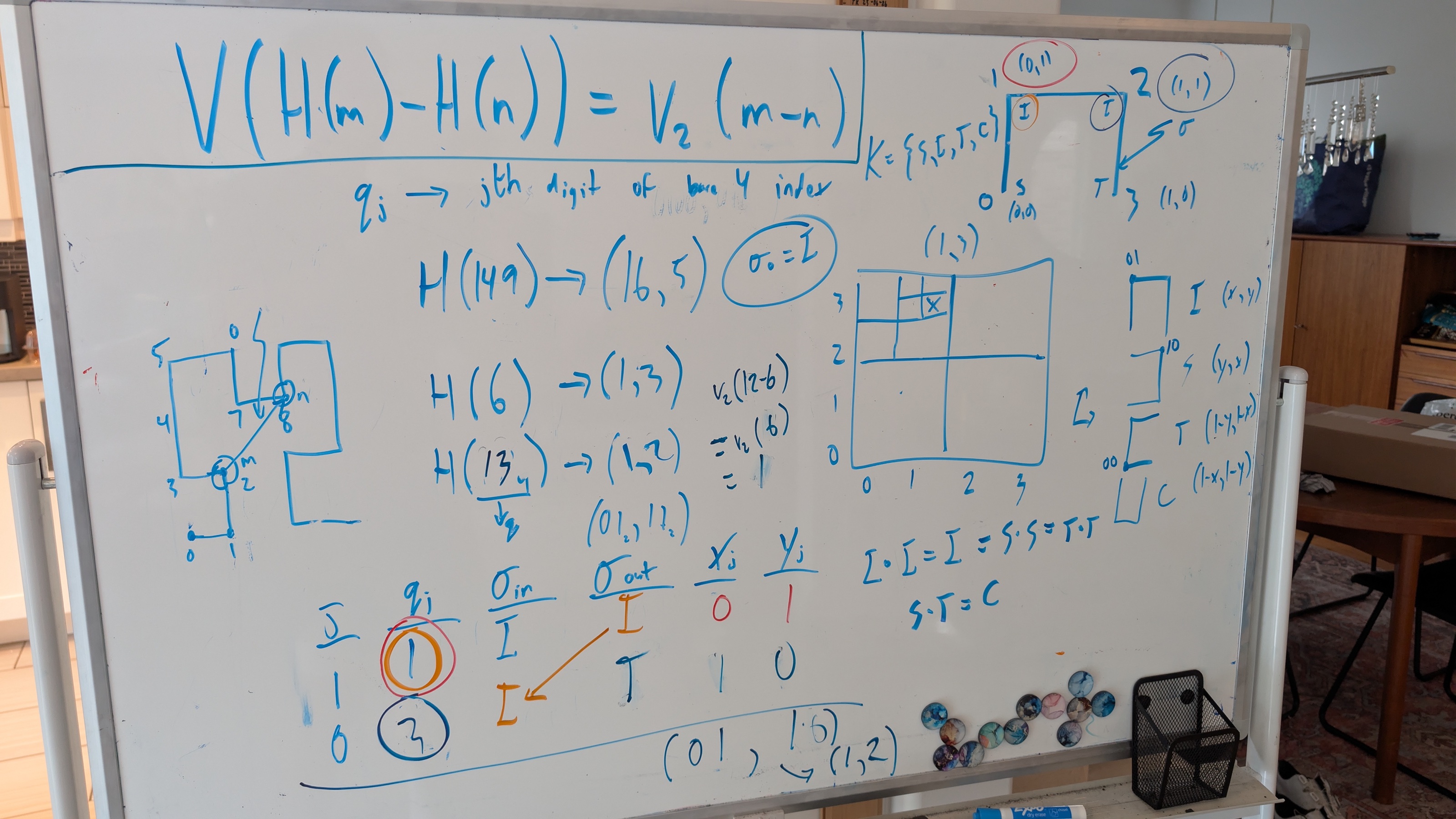
The contradiction was clear, but its engine still needed a mental model. This board pulls apart the Hilbert decoder: base-4 digits, emitted coordinate bits, and the four terminal transformations.
The pair law dominates the top edge. Concrete Hilbert indices occupy the centre; the four state transformations and their bit actions are collected on the right.
What changed in understanding
The identity
\(V(H(m)-H(n))=\nu_2(m-n)\)
became a decoder statement rather than a mysterious metric fact. A first unequal base-4 digit determines the two-adic scale. Equal terminal states let the later common suffix be unwound, so it cannot erase that first mismatch.
Marks worth reading
The large pair-law identity across the top.
Examples such as \(H(149)\), \(H(6)\), and \(H(13)\), used to test the decoder by hand.
The square showing the Gray-code child order.
The state actions \(I,S,T,C\) on a bit pair and the Klein-four composition notes.
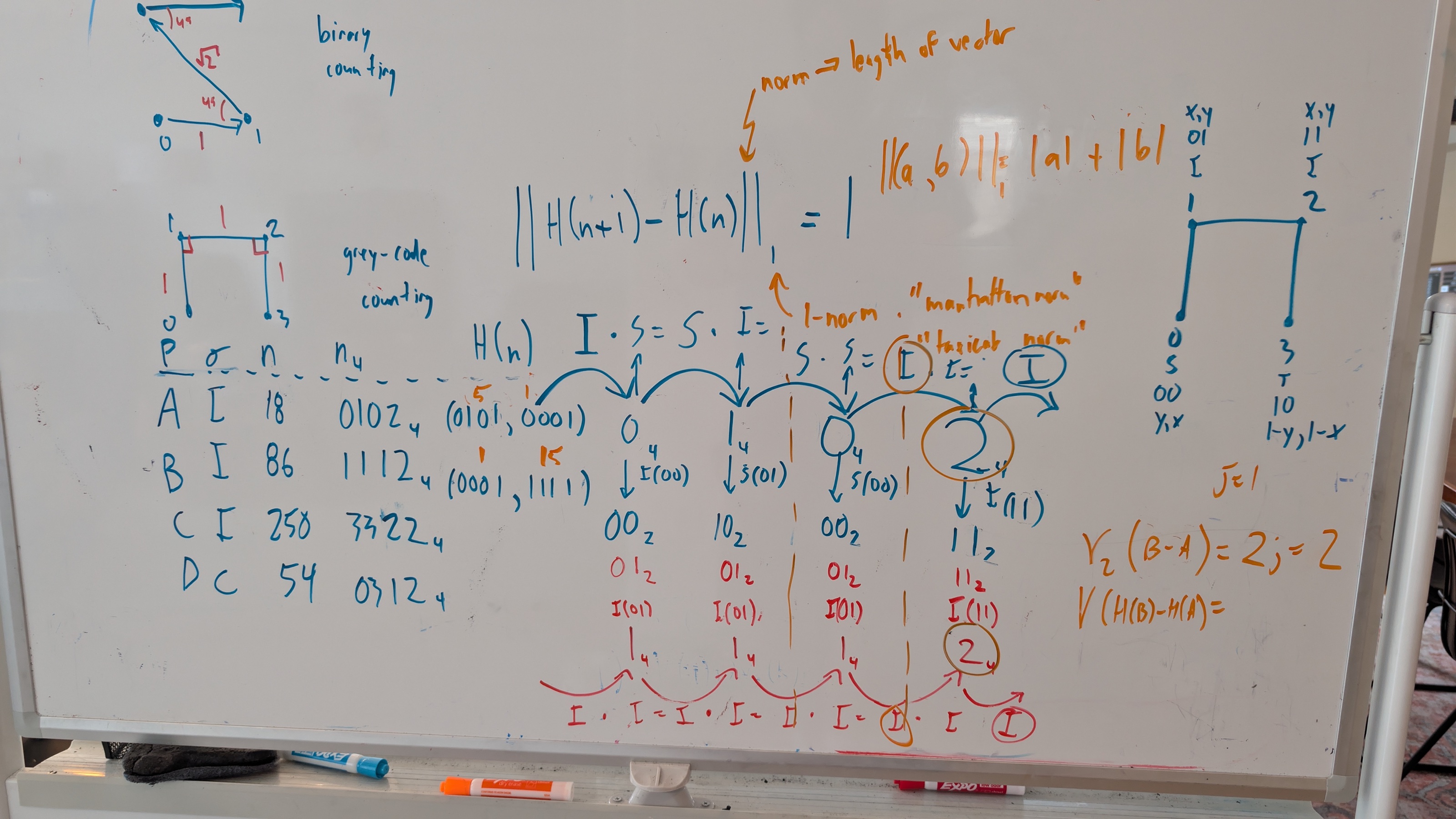
The last board replaces the broad state diagram with a concrete trace. Base-4 words are read from one end while their emitted coordinate bits land at binary places counted from the other.
Candidate indices and base-4 words on the left; state updates and emitted bit pairs through the centre; the first-mismatch valuation check on the right.
What changed in understanding
The proof’s opposite directions became visible: the decoder reads high base-4 digits first, but a digit \(q_j\) writes coordinate bits at binary place \(j\). Tracing the states backward from a common terminal state recovers the state entering the first mismatch.
At the worked scale \(j=1\), the board records \(\nu_2(B-A)=2j=2\) and compares it with the planar chord invariant. This is the local calculation formalized by the first-mismatch lemma.
Marks worth reading
The unit-step reminder \(\lVert H(n+1)-H(n)\rVert_1=1\).
Several candidate indices rewritten as base-4 words.
Blue emitted bits and red accumulated-state notes.
The circled mismatch digit and the calculation \(\nu_2(B-A)=2j\).
The original replay decoded the Hilbert path and made every state convention explicit. The live editor now runs the formula-matched Gaussian generator directly.
The replacement makes the simplification visible: binary digit sum chooses one complex direction, the closed corner formula supplies the tag, and \(W,H\) are appended directly.
The constructor accepts any prefix length \(n\); the browser selects a manageable \(n\) and then runs the exact identity, step-menu, and collinearity checks.
Behind the formal files and polished diagrams was a working desk: a well-used laptop, a larger display, adapters, network hardware, and the ordinary clutter of sustained study.
The workstation behind the lessons, whiteboards, code, and proof artifacts. Select the photograph to open it at full size.
Why include the desk
The finished argument can look inevitable when presented as a clean sequence of definitions and lemmas. The workspace records the less tidy human process around it: reading, drawing, testing, revising, and returning to the same hard idea.
From workspace to proof
The laptop and display held the notes, code, and formal development side by side.
The nearby whiteboards made the pair law and parity contradiction spatial before they became concise prose.
The final authority remains the written proof and Lean project, not the photograph or working notes.
One iteration phase reduced the proof to thirteen lines of Python.
Preparing the unconditional result for publication prompted a concentrated exchange: expose the first proof, remove its selector, then isolate the Gaussian common core. Each revision preserved the same two-adic obstruction while making the construction smaller.
01 · Publish
Bounded-gap Hilbert selector
Kalviainen's first unconditional construction selected one matching orientation from each aligned block and was formalized in Lean.
02 · Refine
All-index tagged Hilbert lift
Cambie's cyclic planar and height tags extended the pair law to every Hilbert index, removing the selector.
03 · Simplify
Binary digit sums replace Hilbert
Cambie isolated \(u_n=i^{s_2(n)}\); Kalviainen checked and formalized the joint Gaussian proof and built its exact generator and visualizations.
What changed
This was one publication-driven refinement phase, not three disconnected research episodes. The witness moved from selected Hilbert indices, through all-index tags, to a Gaussian digit-sum recurrence without changing the valuation argument at its core.
The complete period-eight audit finds 226 rules with 14 spatial step types, 28 with 10, and just two with six: g85 and g170. Their complete menus are now visible in the family explorer, independently of preview length.
One rule, two site-rendered views. Left: the planar G85 source walk. Right: its tagged 3D lift, projected and height-compressed for legibility. Both open G85’s exact vector menu. These finite 1,024-vertex previews illustrate the draft; they do not prove its infinite claim.
Kalviainen’s alternating signed-Gaussian draft builds on the original Cambie–Kalviainen theorem, Cambie’s offsets, and Shallit’s positive-basis encoding (16D, then Cambie’s 14D simplification). Eight transitions collapse to six distinct 3D vectors; encoding these as six basis directions gives the proposed 6D construction.
This proposes reducing the 14-vector upper bound in Adenwalla’s September 6 forum comment to six, by changing the source rule rather than recounting his subsequence. A separate analytic argument gives a minimum of six within the stated four-state tagging scheme. Neither that restricted minimum nor the exact finite audit settles the global minimum: four and five remain unresolved.
Review boundary: the infinite six-step argument has an AI-assisted audit, but independent human review and Lean certification remain pending. The original Erdős 193 proof is unchanged.
The first Hilbert staircase failed almost immediately. Later, even after the formal argument existed, teaching it exposed places where compact language hid essential distinctions. This timeline keeps both kinds of progress visible.
Lift a Hilbert path into 3D
Kalviainen explored using the Hilbert index as height. The plain lift failed, but its four terminal orientations exposed a useful two-adic state.
Keep only one terminal orientation
Kalviainen proved the same-state pair law and used a two-digit suffix rule to choose one representative per block. This produced the project's first unconditional infinite walk and first Lean theorem.
One iteration phase strips away the machinery
Kalviainen published and formalized the bounded-gap Hilbert proof; Cambie removed the selector with all-index tags, then isolated the Gaussian digit-sum core. Kalviainen checked and formalized the joint simplification and rebuilt the exact generator and visualizations around its 16 steps.
The joint paper appears on arXiv
arXiv assigned the permanent identifier 2609.01766 to the Cambie–Kalviainen paper in math.CO.
Unconditional theorem and public preprint; outside review pending
The paper proof and Lean theorem are complete and publicly available. External mathematical review and community acceptance remain pending. The finite computations illustrate and independently check the construction; they are not premises.
Three length ratios certified; the minimum dimension remains open
A written descent argument and separately checked finite-state certificates exclude collinear triples with successive interval-length ratios 1:1, 1:2, and 2:1 in Jeffrey Shallit’s five-letter candidate, at every length and position. These are computer-assisted fixed-ratio results, not a prefix extrapolation or a complete five-dimensional construction. Arbitrary ratios remain unresolved.
An exact affine-state certificate now excludes every adjacent-length ratio in [2557199/2557201, 2557201/2557199] in Shallit’s five-letter candidate, at every position and scale. This is a very narrow interval around equal gaps, not the full 1:2-to-2:1 range and not a complete five-dimensional construction.
The interval certificate has expanded substantially: it now excludes every adjacent-length ratio from 49:51 through 51:49 in Shallit’s candidate, at every starting position and scale. A separately implemented exact checker verified 21,694 affine states and all 37,528,109 clock/order-admissible digit transitions.
This is an interval theorem, not sampled-ratio evidence, but it still does not cover the full 1:2-to-2:1 range or establish a complete five-dimensional construction. The larger-range search remains inconclusive; the minimum dimension remains open. The written reduction awaits outside mathematical review and is not Lean-formalized. Argument, certificate, independent validation, and remaining gap.
Two direction classes excluded at every ratio
A new 3,691-state centered-return certificate excludes collinear triples parallel to (1,1,1,1,1) in Shallit’s candidate at every position, length, and gap ratio. A separate finite-language cover excludes directions missing a letter. Both checks pass independently of the producer’s transition implementation.