Learn the Gaussian proof
1Binary digit sums steer a lattice walk
The state \(u_n=i^{s_2(n)}\) cycles through \(1,i,-1,-i\). Add that state to the current Gaussian integer:
Appending a binary digit gives the self-similar recurrence
2Matching directions let a chord be halved
If \(u_m=u_n\) and the gap is even, both indices have the same last bit. Remove it. The states still match and the chord loses one factor of \(1+i\). Repeat until the gap is odd.
The last squared norm is odd because an odd number of horizontal or vertical unit steps makes the sum of its two coordinates odd.
3A square corner and a height digit remove the matching-state restriction
Equal states use the halving law. Adjacent corners make both sides odd. Opposite corners make both sides exactly divisible by two. Therefore every pair satisfies
4A line would assign the same order to \(A\), \(B\), and \(A+B\)
For three points in increasing order, let \(A,B\) be the adjacent positive height gaps. One common slope and the three pair laws imply
Remove the common power of two from \(A\) and \(B\). Both are then odd, so their sum is even. The third valuation must be larger. Contradiction.
5Four current directions times four next directions give sixteen steps
The planar part is twice one Gaussian unit plus a square-corner correction. Its coordinates have absolute value at most \(2\). The height increment is between \(1\) and \(7\).
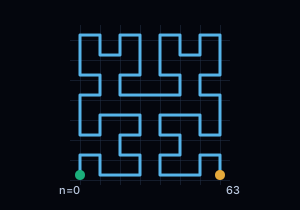
The Hilbert curve still explains the geometry
The previous Hilbert proof supplied four terminal orientations of a recursively filled square. Encoding those orientations as Gray-code corners and height residues revealed the tag-and-lift architecture. The current proof uses Gaussian directions instead, but keeps the same square, state, chord, and 3D geometry.