An infinite small-step \(\mathbb Z^3\)-walk with no collinear triple
Theorem. There is an infinite sequence \(P_0,P_1,\ldots\) in \(\mathbb Z^3\) with no three collinear terms and with every successive displacement in \(\{-2,-1,0,1,2\}^2\times\{1,2,\ldots,7\}\). Only sixteen successive displacement vectors occur.
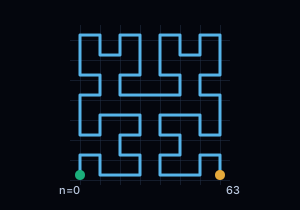
Walk. Follow four Gaussian units selected by binary digit sums.
Tag. Write the direction as both a square corner and a height residue.
Obstruct. Three chord valuations cannot coexist on one line.
1. The Gaussian nearest-neighbor walk
Let \(s_2(n)\) be the number of \(1\)s in the binary expansion of \(n\). Define
Every increment \(z_{n+1}-z_n=u_n\) is one of \(1,i,-1,-i\). Splitting an index by its last binary digit gives
2. Equal states give an exact halving law
Assume \(m<n\) and \(u_m=u_n\). If \(n-m\) is even, the indices have the same last binary digit: \(m=2a+\varepsilon\), \(n=2b+\varepsilon\). Equality of the states descends to \(u_a=u_b\), while
Multiplication by \(1+i\) doubles the squared modulus and therefore adds one to its two-adic valuation. Repeat exactly \(r=\nu_2(n-m)\) times. The remaining gap is odd, so the remaining chord is a sum of an odd number of Gaussian units. Writing it as \(x+iy\), the sum \(x+y\) and hence \(x^2+y^2\) are odd. Therefore
3. Encode the direction state twice
Write \(u_n=i^{\alpha_n}\), where \(\alpha_n\in\{0,1,2,3\}\). Use the four corners of one unit square in cyclic Gray-code order:
Double the Gaussian point to open one low planar bit in each coordinate, and append the same state to the height modulo four:


4. The all-pairs identity
For \(m<n\), put \(a=\alpha_m\), \(b=\alpha_n\), and \(d=n-m\). Then
- If \(a=b\), the tags cancel and the equal-state law applies; doubling adds two to both valuations.
- If \(b-a\) is odd, the corners are adjacent. Exactly one planar coordinate is odd, and the height gap is odd.
- If \(b-a=\pm2\), the corners are opposite. Both planar coordinates are odd, so their squared sum is \(2\bmod4\); the height gap also has valuation one.
Thus every pair—not merely equal states—satisfies
5. Three such chords cannot lie on one line

Suppose \(P_a,P_b,P_c\) are collinear for \(a<b<c\). Put
Strict height growth gives \(A,B>0\), and collinearity gives one common complex slope:
Taking squared moduli of the common slopes and applying the all-pairs law to the three chords forces
Odd plus odd is even.
If the first two valuations equal \(t\), then \(A/2^t\) and \(B/2^t\) are odd. Their sum is even, so \(\nu_2(A+B)>t\), contrary to the third equality.
6. Sixteen bounded steps
Successive differences are
The Gaussian direction points outward from its matching square corner, so the corner correction never extends its outward component. Hence \(|dx|,|dy|\le2\), while \(1\le dz\le7\). The ordered pair \((\alpha_n,\alpha_{n+1})\) determines the step, so at most sixteen steps occur.
Development and author contributions
The present formula is the third construction in the project. Erik Kalviainen developed the first bounded-gap Hilbert selector, its Lean formalization, exact checks, and the interactive proof site. Stijn Cambie then proposed two successive simplifications: first the all-index state tags that removed the selector, then the Gaussian digit-sum walk that removed the Hilbert machinery.
Cambie's simplifications and drafts and Kalviainen's formalization and presentation were AI-assisted. Kalviainen migrated the Gaussian argument into Lean and developed the compact generator, finite artifacts, and visualizations. Both authors have checked the proof and state the result as an unconditional theorem; neither AI output nor finite computation is a premise. The paper, arXiv:2609.01766, lists Stijn Cambie and Erik Kalviainen in alphabetical order; S.C. is supported by FWO grant 1225224N. The timeline records the publication and refinement phase.
Hilbert193.erdos193_unconditional checks the Gaussian construction against pinned Lean and Mathlib revisions.
Stijn Cambie and Erik Kalviainen both affirm the unconditional result; neither AI output nor finite computation is a premise.
The Python and 3D prefixes check finite instances. The infinite theorem is the argument above and its Lean formalization.