Family rule
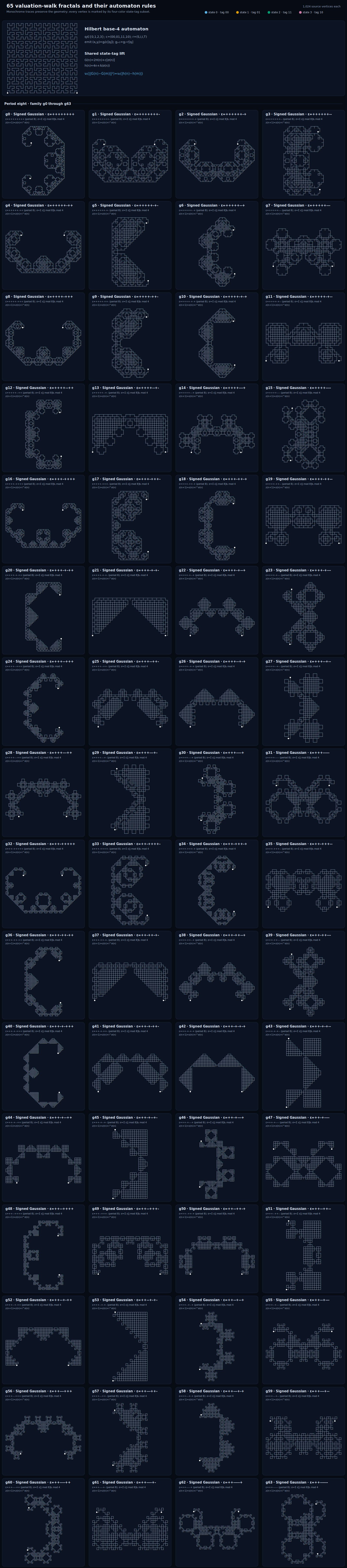
g0 · ε=++++++++
g0–g255 have period 8; g256 begins period 9; g768 begins period 10.
pinch/scroll to zoom · drag to pan · select a vertex · double-click to reset
Dynamic 3D preview ready
Formula

σ(n)=Σ ε[j mod 8]bⱼ(n) mod 4 · z(n+1)=z(n)+i^σ(n)

* Signed-family 3D lifts are dynamically generated finite previews and have not been independently verified.

Complete menu · integer coordinates (x, y, h)

3D step vectors for the selected rule

These are the steps of the tagged 3D lift, not the four unit directions of the planar drawing. The menu is exact for the whole periodic rule, independent of recursion detail or the displayed prefix.

exact step vectors
shortest length
longest length
white origin · colored vector lines · bright endpoints · drag to rotate
Formula and why this is a complete menu

Use σ(n) = Σ εⱼ bⱼ(n) mod 4, z₀ = 0, zₙ₊₁ = zₙ + iσ(n), and Cambie’s offsets (c₀,c₁,c₂,c₃) = (0,−1,−1+i,−i). Then Qₙ = (Re(2zₙ+cσ(n)), Im(2zₙ+cσ(n)), 4n+σ(n)). Translate Q₀ to zero if desired (here it already is zero).

A transition r → s gives (Re(2iʳ+cₛ−cᵣ), Im(2iʳ+cₛ−cᵣ), 4+s−r). With k trailing ones, the state change is εₖ − Σⱼ<ₖ εⱼ mod 4. For a period-p sign word, four periods exhaust this change orbit; bits above the carry suffix realize every starting state. Equal vectors are merged in the list. This exact finite calculation counts step types; it is not itself a proof of infinite triple avoidance.

Complete static atlas